Candy Critters: Idle Merge
- 4.6
- Rating
- 500.00K
- Installs
- Free
- Price

 Analysis by App-foxy
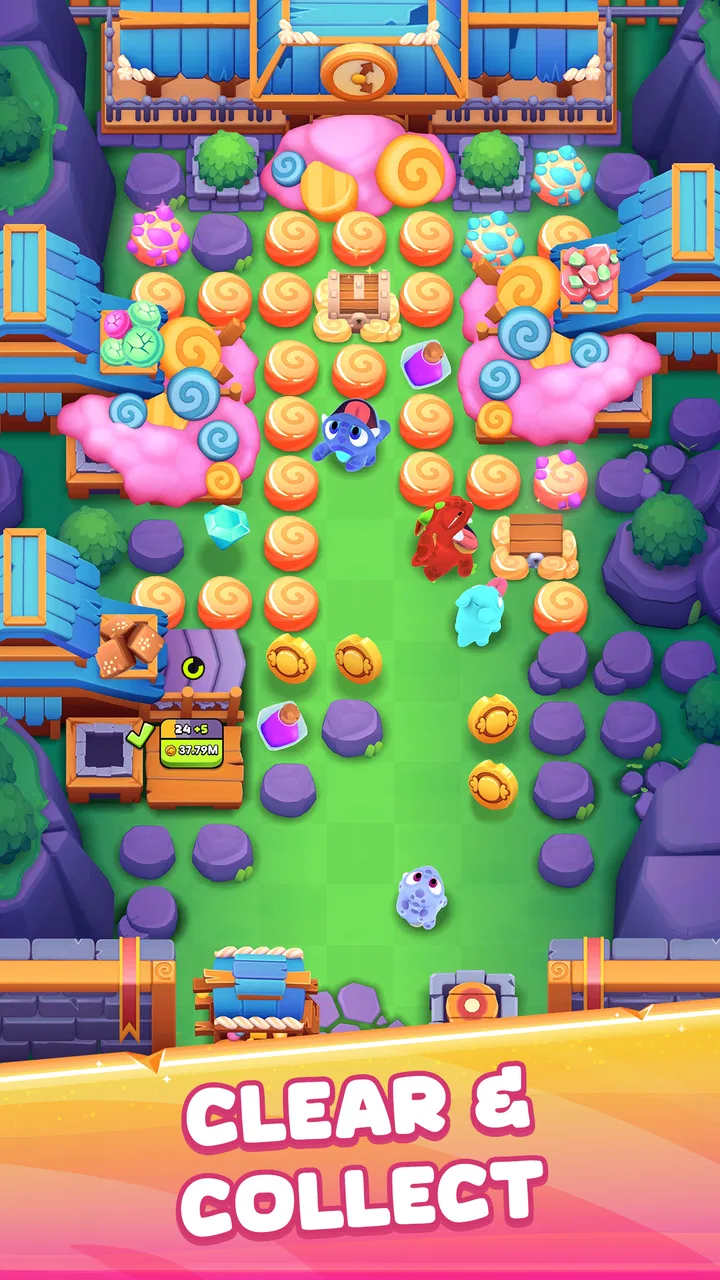
I went into Candy Critters: Idle Merge expecting a light matching game, but its appeal is a little more specific: it combines creature collecting, candy-clearing puzzles, and an idle rhythm that lets progress continue without demanding constant attention. It is a free simulation game from PlaySide Studios, aimed at Everyone, and it works best when you want something cheerful to check in on rather than a game that requires long, intense sessions.
The basic idea is easy to understand. You merge Chomplets, work through candy-filled spaces, and gradually uncover more of Sweetopia. That sounds simple, and the opening is deliberately approachable, but the enjoyable part comes from deciding when to spend a move, when to combine creatures, and when to leave the game alone for a while so your progress can build. I found it most satisfying in short visits: a few actions while waiting for coffee, another quick session during a commute, and a longer look when I wanted to plan the next useful merge.
Getting started without feeling lost
The first thing I recommend is resisting the urge to tap through every prompt as quickly as possible. The early game is designed to teach the loop, so the first candy-clearing actions are more important than they may appear. I treated those opening moves as a tutorial for the whole experience: observe what can be combined, notice what the board is asking me to remove, and pay attention to which action creates the clearest improvement.
You May Also Like

 Pandora - Music & Podcasts
Pandora’s Music Is Easy to Start, but Harder to Recover
Pandora’s strength is its low-effort path from a seed to a station. Its weak spot is how much confidence it asks you to place in connection, setup, and quiet recovery.

 8 Ball Pool
 Is Built on Rivalries, Rematches, and Routine
A close look at the rivalries, rematches, shared routines, and unanswered safety questions that turn a quick pool match into a persistent mobile community.

 Samsung Music
’s Quiet Strength Is Playing What You Already Own
Its reach comes less from spectacle than from dependable access to a personal library. That simplicity is both the app’s strongest retention engine and its ceiling.

 AccuWeather: Weather Radar
AccuWeather Review: A Quick, Clear Forecast for Everyday Decisions
For everyday plans, the best forecast is the one you can understand quickly. AccuWeather makes rain timing, radar, and local conditions easy to act on, with a few trade-offs.

 Hill Climb Racing
Why Hill Climb Racing Still Turns Crashes Into One More Run
A tiny car, a bumpy hill and one more upgrade: Hill Climb Racing keeps resurfacing because its simple chaos makes every near-miss feel personal.

 AliExpress - Shopping App
AliExpress Makes Global Shopping Feel Personal, but Shoppers Bear the Risk
AliExpress turns a global marketplace into a pocket-sized discovery engine. Its reach is useful, its shopping loop compelling, and its trade-offs easy to miss.
More From Our News Desk
View All News


There is no complicated setup before playing. The game is available at no charge, supports devices running Android 6.0 or later, and its content rating makes it suitable for a broad audience. The current version is 1.6.14, so anyone installing it should still take a moment to check that the device has enough room and that the operating system is compatible before starting.
I also suggest beginning with a simple personal rule: do not spend anything immediately. In-app purchases range from $0.99 to $99.99 per item, and the free opening is enough to show whether the merge-and-clear rhythm suits you. Waiting gives you time to decide whether optional spending would genuinely improve your experience or merely make the early game feel faster.
Your first useful goal
For a first-time player, the first meaningful success is not collecting everything or trying to clear an entire area in one sitting. It is making a merge that visibly improves your position while also opening space for the next action. I found that this small change in mindset prevented the board from becoming a series of random taps.
Look for combinations that solve two problems at once. A merge should ideally give you a stronger Chomplet and make the surrounding candy easier to manage. If you always choose the first available combination, you may gain something immediately but leave the rest of the area awkwardly arranged. Taking a few seconds to scan the whole play space is more useful than rushing.
That is the first non-obvious strength of the game: the merge action is simple, but the order of actions affects how comfortable the next few moves feel. I began to think of each turn as preparation rather than a reward by itself. Clearing a small obstruction can be better than creating a larger creature if that clearance exposes a more valuable opportunity.
How the idle side fits the puzzle side
The idle element changes how I approach the game. Unlike a purely manual puzzle title, it does not make every minute of progress depend on constant concentration. That makes it friendly to irregular schedules. I can play actively when I have time, then return later without feeling that I have missed the entire experience.
However, idle progress is not a replacement for making decisions. The game is more enjoyable when I use the quieter periods to think about my next visit rather than treating them as the whole game. If you only want an automatic number to rise, this may feel too interactive. If you like checking in, making a few choices, and leaving again, the balance is much more appealing.
A realistic everyday routine would be to open it in the morning, make one careful merge instead of several impulsive ones, and then close it. Later, I would return to inspect what changed, clear the most useful piece of candy, and decide whether the new creature should be merged immediately or held for a better arrangement. That routine makes the game feel like a small daily habit rather than a task that takes over the phone.
Where new players commonly hesitate
The biggest early confusion is understanding whether every available merge should happen at once. My experience says no. Some combinations are helpful because they create room, while others can leave the board less flexible. The game does not need to be played with perfect planning, but a short pause before merging is worthwhile.
Another point of friction is the relationship between clearing candy and improving Chomplets. These goals are connected, but they are not always identical. A move that advances one may not be the best move for the other. When I felt stuck, I stopped asking, “What can I combine?” and asked instead, “What is blocking the next useful combination?” That question usually produced a clearer choice.
It is also easy to assume that a larger creature is automatically the best immediate outcome. Bigger is attractive, but timing matters. Keeping a smaller piece temporarily can preserve options and make the next sequence smoother. This is especially useful when the available space is tight and one careless merge leaves several pieces stranded in inconvenient positions.
Making the first session feel successful
I would define a good first session as one where you learn three things: how the merge action changes the board, how candy removal opens future choices, and how the idle rhythm affects when you return. You do not need to understand every longer-term possibility at once. The game becomes less intimidating when you measure progress by improved decisions rather than by how much of Sweetopia you reveal immediately.
My practical advice is to use the opening area as a low-pressure experiment. Try one direct merge, then look at the new arrangement before acting again. Notice whether the result creates room or simply moves the problem elsewhere. This makes the first successful action feel earned and gives you a repeatable method for later areas.
The best early habit is to create space before chasing the most impressive-looking merge. That habit is useful because it keeps the board flexible, reduces accidental dead ends, and makes the candy-clearing side feel connected to the creature-collecting side instead of like a separate activity.
What the game does well after the opening
Once the first few actions make sense, the charm comes from the combination of gentle presentation and small decisions. The creature theme gives the merges a sense of purpose, while the candy setting keeps the visual language light. I never felt that the game was trying to overwhelm me with complicated rules, which is a major advantage for younger players, casual players, or anyone who prefers learning through action.
The simulation label is useful here because the experience is not only about solving a single board. It is about gradually developing a space, improving what is available, and returning to see how the ongoing loop has changed your options. That makes it different from a traditional match-three game where the main satisfaction comes from clearing a level under immediate pressure.
Compared with a standard idle game, this one gives me more to do during an active visit. I am not just collecting a reward and leaving; I am deciding how to use the available creatures and candy. Compared with a strict puzzle game, it is less demanding because the idle structure softens the need to complete everything in one uninterrupted attempt. The trade-off is that players seeking deep competitive challenge may find it too relaxed.
Three useful ways to play
My preferred approach is the “space first” method. I clear or merge whatever is preventing several future options from appearing, even when that action is not the most visually exciting. This is especially helpful after returning from a break, when the board may contain several tempting but poorly timed combinations.
A second approach is to use short planning pauses. Before tapping, I identify the next two likely actions rather than planning an entire chain. Planning too far ahead is unreliable because one merge can change the available arrangement, but looking one or two steps forward gives enough structure without turning a relaxing game into homework.
The third is to separate active and idle visits. During an active visit, I make the decisions that require attention. During a quick visit, I only collect the obvious improvement and avoid forcing a complicated sequence. This prevents tired or distracted play from creating unnecessary frustration and makes the game fit better around real life.
Where patience matters
The idle design can make progress feel comfortable, but it can also make the pace feel slower if you want immediate access to every discovery. The game rewards returning regularly more than demanding instant completion. I liked that during busy days, but I can see it bothering anyone who prefers a clear beginning and end to each session.
There is also a natural temptation to view purchases as a shortcut whenever progress slows. Because the game is free to start and includes paid items, I would decide on a spending limit before becoming invested. The strongest reason to pay should be that you already enjoy the core loop and want to support or extend that experience, not that you feel pressured by a temporary obstacle.
For families, the Everyone rating is reassuring, but I would still explain the purchase side to younger players. The colorful presentation makes the game approachable, and that also means a child may not naturally distinguish between playing for free and choosing an optional item. A quick conversation about asking before buying is sensible.
Who will enjoy it most
I would recommend it to someone who likes collecting, light planning, and games that can be played in small portions. It is a good fit if you enjoy seeing a modest action improve a larger environment, especially when you do not want the pressure of a timer or a demanding competitive ladder.
It also suits players who like having something to return to. The idle structure gives the game a reason to become part of a routine, while the merge decisions keep each visit from being completely passive. The combination is particularly convenient for people who play on a phone in scattered moments rather than setting aside a dedicated gaming session.
I would skip it if your priority is complex strategy, fast reflexes, or a strong competitive component. I would also look elsewhere if you dislike waiting between active decisions or if you want a puzzle game with tightly defined levels and a clear final solution. In those cases, a traditional match-three or strategy title will probably feel more rewarding.
My verdict after settling into Sweetopia
After spending time with it, I see Candy Critters: Idle Merge as a friendly middle ground. It is more interactive than a basic idle collector, but less demanding than a serious puzzle simulation. The creature merges are easy to begin, yet the order of actions gives careful players something to think about. The candy-clearing layer provides immediate goals, while the larger Sweetopia setting gives those small decisions a sense of direction.
The main limitation is also part of its identity: the relaxed pace will not satisfy everyone. Players who want constant novelty may find the idle rhythm repetitive, and players who want deep tactical systems may outgrow the decision-making. I also think the purchase range deserves deliberate handling, particularly for families and anyone who is susceptible to spending when progress slows.
The game has built a healthy audience, with an average rating of 4.6 from around 11 thousand ratings and more than 500 thousand installs. Those figures do not replace personal taste, but they fit my impression that the game is easy to approach and pleasant to revisit. Its Everyone rating reinforces that broad, low-pressure character.
For me, the best way to start is simple: install it, make the opening merges slowly, prioritize space, and return later to see what the idle loop has prepared. Do not judge it by how quickly you can reach the next discovery. Judge it by whether a short visit leaves you with one satisfying decision and a clear reason to come back. If that sounds like the kind of mobile game you want, PlaySide Studios has made a welcoming option that earns a place in a casual rotation.
FAQs for Candy Critters: Idle Merge
01What is Candy Critters: Idle Merge, and how is the gameplay structured?
Candy Critters: Idle Merge is a casual idle game built around combining matching candy-themed creatures to create stronger characters. You merge units, unlock new critters, and gradually improve your production while the game continues generating progress in the background. The controls are simple and suitable for short sessions, although the experience becomes more strategic as you decide which creatures to combine, upgrade, and place.
02Can Candy Critters: Idle Merge be played offline?
The core merging and idle progression can generally be enjoyed without a constant internet connection, which makes the game convenient for quick play while traveling or when mobile data is unavailable. However, some features may require connectivity, including advertisements, online rewards, cloud synchronization, events, updates, or purchases. It is best to open the game online occasionally so progress and account-related features can update correctly.
03Does Candy Critters: Idle Merge contain advertisements or in-app purchases?
Candy Critters: Idle Merge may include optional advertisements and in-app purchases, as is common with free-to-play idle games. Ads can sometimes be used to claim bonus rewards, speed up progress, or receive additional resources, while purchases may provide currency, boosts, or convenience items. You can usually progress without spending money, but patience and regular play may be necessary at higher stages.
04Is Candy Critters: Idle Merge suitable for children?
The colorful presentation, simple controls, and non-violent merging mechanics make Candy Critters: Idle Merge approachable for younger players. Nevertheless, parents should review the game’s age rating, advertising practices, and purchase settings before allowing unsupervised play. If the device is shared with children, enabling purchase restrictions is recommended because optional items or premium currency may be available through the application.
05What should I know about progress, device compatibility, and data before downloading?
Before downloading Candy Critters: Idle Merge, check that your Android or iOS device meets the current store requirements and has enough free storage for the installation and future updates. Idle games can accumulate significant progress, so avoid deleting the app or changing devices without confirming whether cloud saving or account synchronization is supported. Progress recovery may depend on the platform, login method, and the game’s own backup system.
Pros
- Simple merge mechanics are easy to learn and play with one hand.
- Idle rewards provide progress even during short breaks from the game.
- Colorful animal designs make the game appealing to younger players.
- Short sessions work well for casual play while commuting or waiting.
- Frequent upgrades create a clear sense of progression over time.
Cons
- Progress can slow noticeably without regular merging or upgrades.
- Repeated actions may feel monotonous after extended play sessions.
- Some features may encourage watching ads for faster rewards.
- The small interface can feel crowded on phones with compact screens.
- Limited strategic depth may disappoint players seeking a challenging puzzle game.

Candy Critters: Idle Merge
Gallery